

Hampi Monuments - Stories Hidden In Stones

Updated: 3 hours ago
All the monuments in Hampi are a treat to the eyes, and located at a picturesque location, but all of them seemed quite different from the usual temples and monuments I have come across so I tried to get more details. Everything that I saw and heard about these monuments left me in awe, and I want to share some of those stories here in this blog on the places I loved the most.
Virupaksha Temple

According to the tale, Pampa was the daughter of Brahma, the creator of the universe. She performed intense penance and meditation to win the love of Lord Shiva, who was meditating in the forests of Hemakuta Hill, near present-day Hampi. Pampa's devotion and determination impressed Shiva, and he eventually agreed to marry her, and the place where the marriage took place is believed to be the Virupaksha Temple. Pampa is considered an incarnation of Parvati, and Shiva, as her consort, is revered in this temple as Virupaksha (a form of Shiva).
The temple is considered an auspicious and sacred place for weddings, especially because of its association with the divine marriage of Pampa and Lord Shiva (Virupaksha). Couples and their families seek blessings from the deity for a prosperous and harmonious married life.
The temple has many mysteries such as the pinhole camera effect - The temple features an optical marvel where the entrance tower’s shadow is projected upside-down on the walls of a small chamber, showcasing the advanced knowledge of light and reflection by ancient builders. The temple is also believed to have many unexplored underground chambers whose importance is still not clear. I also saw 3 Nandis at the entrance which was very unique.
It is the only temple in Hampi which still stands in its original form without any sight of ruins. It was spared from complete destruction during the invasions and the temple has been a sacred pilgrimage site and continues to attract devotees to this day. I started exploring Hampi by visiting Virupaksha Temple first as many travelers do and I would recommend the same to anyone visiting Hampi :)
Vijaya Vitthala Temple

Vijaya Vitthala temple was built during the reign of Devaraya II, one of the greatest rulers of the Vijayanagara Empire, in the early 15th century.
The stone chariot is the most fascinating feature of the temple, the chariot has with rotatable wheels, which, though now fixed to prevent further damage, were once designed to spin, demonstrating the advanced engineering of the artisans. Its prominence grew after being featured on the ₹50 Indian currency note, immortalizing it as a cultural icon of India.
The temple is also famous for its musical pillars, which are made of stone but resonate like musical instruments when struck. The pillars, known as "Saree pillars," are said to be designed to produce different sounds resembling the notes of a traditional Indian musical scale.
Some say that the monument was erected to keep the Vitthala idol saved from Pandharpur when South India was being invaded, but there has been no official proof of this.
Lakshmi Narasimha Temple

The huge monolithic sculpture of Lakshmi Narasimha is one of the most amazing works of Vijayanagara. This 6.70 m. height statue was consecrated by priest Krishna Bhatta at the behest of Krishnadevaraya in 1528. Narasimha, the fourth incarnation of Lord Vishnu, is found seated in yogic posture on the giant coils of Adishesha. I always knew Narasimha as the lion face incarnation of Lord Vishnu who ferociously killed the demon Hiranyakashyapu in his lap by disemboweling him. However in this statue, I was surprised to see that the same Narasimha is seen as serenely smiling and radiating love with Goddess Lakshmi seated on his lap.
The seated figure of his consort Lakshmi on his left lap is missing which is believed to be destroyed by Deccan Sultanates after the battle of Talikota but the hand of Goddess Lakshmi is still visible.
Later I came to know that Narasimha also has 5 forms and ferocious Narasimha who killed the asura is just one of them.
Hazara Rama Temple

This temple dedicated to Lord Rama was built by King Devaraya I in early 15th Century, the name literally means "Thousand Ramas". The entire temple is carved with episodes from Ramayana. These proceed in clockwise direction around the walls of the mandapa.
Outer walls of the temple compound have carvings in which you can see women playing drums in royal ceremonies, and playing water sports at festivals. Some carvings also depicted animals, soldiers and women all progressing towards the king together. It felt like an incredibly advanced society of ancient times, deeply rooted in culture and built on principles of mutual respect.
Also what amazed me the most was how realistic the carvings were, no 2 animals or figures were exactly alike.
Badavilinga
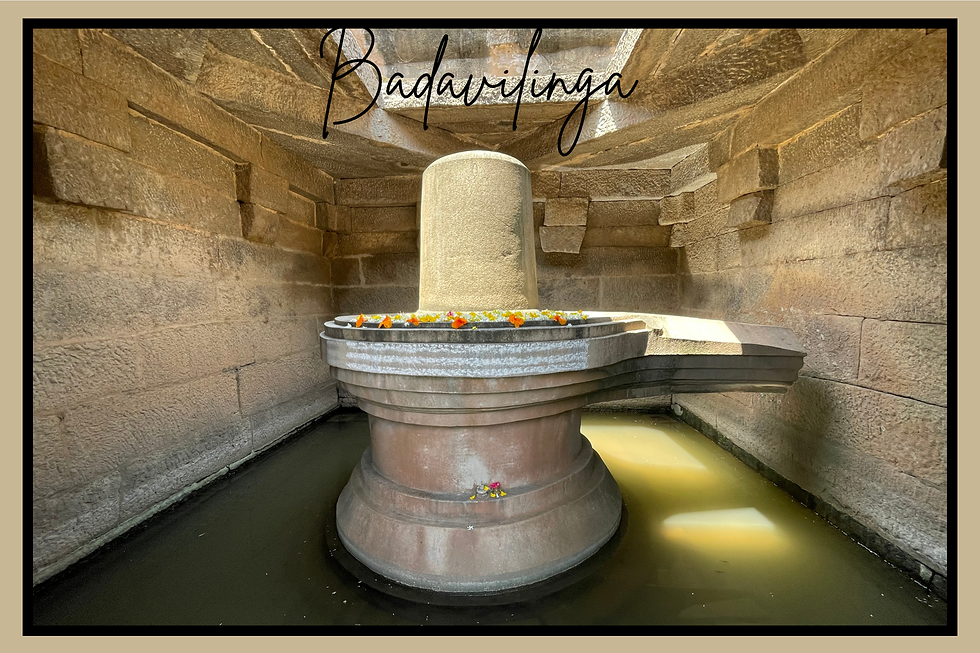
In Kannada language,"Badavi" means poor. This is a huge monolithic Shivlinga constructed out of a single stone and it is believed that there was a very poor women who was an ardent worshipper of Shiva, in spite of being poor, she used every penny she earned in construction of this Shivlinga hence it is named after her. The lower part of the Shivlinga remains in water throughout the year. The water source is a small canal drawn directly from the Tungabhadra river.
Kadalekalu Ganesha
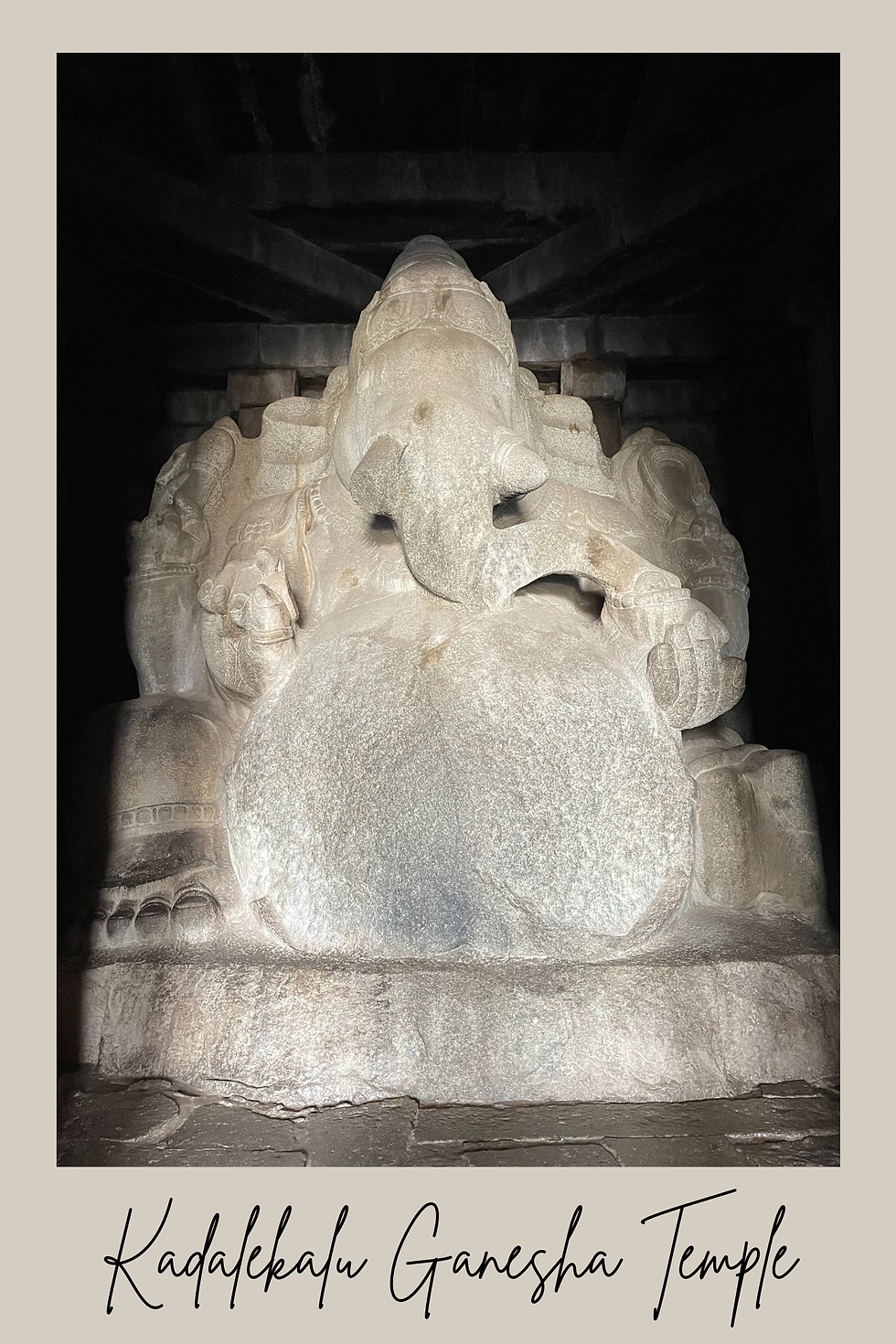
Kadalekalu means chickpea (bengal gram) in Kannada language. It is believed that construction of the idol was sponsored by a chickpea trader. So the belly of Ganesha is constructed in shape of chickpea to honour the chickpea trader, and hence the name. This 15 feet statue is carved out of a single rock and dated to 16 century AD and was definitely the most unique Ganesha idol I have seen till now.
There is another Ganesha idol nearby named Sasivekalu Ganesha, named after Sasivekalu, meaning Sesame seed in Kannada where Ganesha's belly is in shape of sesame seed.
It amazed me that not all the temples in Hampi were built by the kings, some of these were built by merchants and even common people, like Badavilinga which was sponsored by a poor woman, and they stood right in between all other temples built by the great kings of Vijayanagara.
Kodandarama

Kodanda in Sanskrit means 'bow' and refers to Rama's bow. This temple is believed to be the place where Lord Rama crowned Sugriva as the king of Kishkindha after defeating his brother Vali. This temple is not part of any monument cluster and is in a completely different location hence lesser explored. However it was the most beautiful location of the temples in Hampi. It is on the banks of mighty Tungabhadra river and you can also see Anjanadri Hill from here, which is believed to be the birth place of Lord Hanuman. The entire view from temple was breathtaking.

Queen's Bath

The Queen's Bath in Hampi was built during the reign of King Achyuta Deva Raya of the Vijayanagara Empire in the early 16th century. It was constructed as part of the royal enclave and is believed to have been designed for the royal women, including the queen, for private bathing and leisure. What makes the structure fascinating is the advanced water management system it incorporates, including channels that brought water from nearby reservoirs, ensuring a constant supply for the royal family.
What surprised me the most was the monument design, which was Islamic architecture. After trying to study this further I came to know that there is actually a term for this architecture form called Saracenic Architecture which is a style of architecture that incorporates both Hindu and Islamic elements. This shows that the Hindu Kings at that time believed in unity and harmony among all faiths. Some even say that King Devraya II was known for keeping a copy of Quran beside his throne so that he could take oath of his Muslim officers even though Vijayanagara used to be in frequent wars with the Sultanate kingdoms.
There are many such monuments like Elephant Stables and Lotus Mahal which are inspired and built in Islamic manner.
A Glorious Past
All the temples and the carvings speak volumes about India's remarkable past. The carvings at the monuments confirm that Vijayanagara's fame was spread not only in India but all over the world, including Middle East and Europe. Many temple compound walls have carvings depicting European and Arab merchants and officers, one carving even depicts a Turkish guard with long beard and pointed hat. It is believed that 14th and 15th century Vijayanagara empire kings used to have an inner circle of Turkish slaves who acted as officers or guards for the kingdom.

Even the Portuguese are believed to have had strong ties with Vijayanagara in 16th century as they benefited from trading with the kings of the empire. There are also records of Italian and Arab travelers visiting Hampi. A Portuguese traveler names Domingo Paes had quoted Hampi as "The best provided city in the world" in the reign of King Krishnadevaraya.
It's incredible to imagine how advanced and prosperous our kings were, fostering such a modern cosmopolitan culture as far back as the 16th century. I sincerely hope that India regains its past glory someday in the future.


Beautiful, concise and informative.. i have always loved hampi and cant help going back every now & then!
Wow, very informative travelogue, keep writing dear ❤️
Khup chhan mahiti dili aahe
Ek chhan destination explore karnaysathi aamhala detail mahiti milali
Keep travelling and exploring wonderful places
Very nicely written travelogue, taking us back to that glorious era!
Very interesting n informative. Keep travelling n writing . God bless